

 Image 1 of 1
Torque Football Skill Development is a biomechanics-driven training system built to develop explosive, efficient athletes who can separate and perform at game speed.
This is not traditional “cone drill” training.
Each session is structured around Torque principles—how the body loads, rotates, and transfers force through the ground to create speed, separation, and control.
Athletes are trained to move with intent, sequencing, and efficiency, allowing them to execute faster while reducing wasted motion.
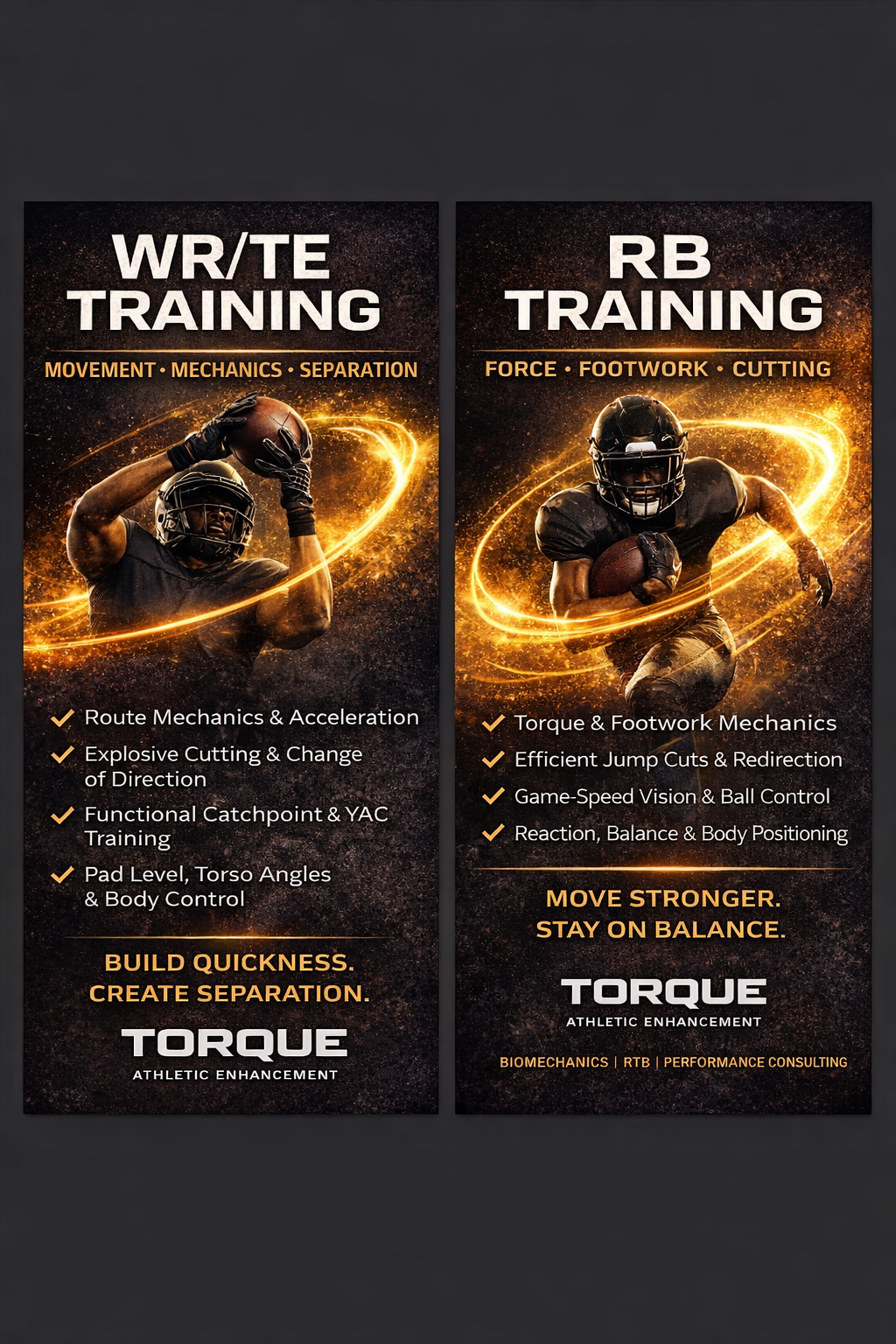
Wide receivers and running backs are developed through a combination of position-specific skill work and rotational performance training:
• Route running through hip loading and directional force application
• Release mechanics vs coverage using lateral torque and front-side control
• Acceleration and top-end speed via ground force and projection angles
• Change-of-direction using deceleration mechanics + re-acceleration sequencing
• Ball tracking and catching under speed + visual stress
• Reaction training and field awareness under live constraints
Sessions also integrate:
• Rotational power development (hips → trunk → upper body sequencing)
• Foot-to-core connection for efficient force transfer
• Adductor and pelvic stability for controlled movement under speed
• Transition mechanics (speed → cut → re-accelerate)
Whether preparing for competition or building long-term athletic capacity, the objective is the same:
Torque Football Skill Development is a biomechanics-driven training system built to develop explosive, efficient athletes who can separate and perform at game speed.
This is not traditional “cone drill” training.
Each session is structured around Torque principles—how the body loads, rotates, and transfers force through the ground to create speed, separation, and control.
Athletes are trained to move with intent, sequencing, and efficiency, allowing them to execute faster while reducing wasted motion.
Wide receivers and running backs are developed through a combination of position-specific skill work and rotational performance training:
• Route running through hip loading and directional force application
• Release mechanics vs coverage using lateral torque and front-side control
• Acceleration and top-end speed via ground force and projection angles
• Change-of-direction using deceleration mechanics + re-acceleration sequencing
• Ball tracking and catching under speed + visual stress
• Reaction training and field awareness under live constraints
Sessions also integrate:
• Rotational power development (hips → trunk → upper body sequencing)
• Foot-to-core connection for efficient force transfer
• Adductor and pelvic stability for controlled movement under speed
• Transition mechanics (speed → cut → re-accelerate)
Whether preparing for competition or building long-term athletic capacity, the objective is the same: